Key Facts
- ◆The dhow has been the primary vessel of Arabian Sea trade for at least two thousand years
- ◆Gulf trade in pearls, frankincense, spices, and dates sustained coastal civilisations long before the oil economy
- ◆The dhow's form — hull, lateen sail, hand-stitched planking — remained essentially unchanged for nearly two millennia
- ◆The UAE dirham and multiple Gulf national symbols incorporate the dhow as an emblem of foundational heritage
- ◆Indian Ocean trade routes connected Gulf ports to Rajasthan and the Makrana marble region centuries before the Mughal period
- ◆A dhow showpiece in a majlis communicates lineage — it is a heritage statement, not a decorative choice
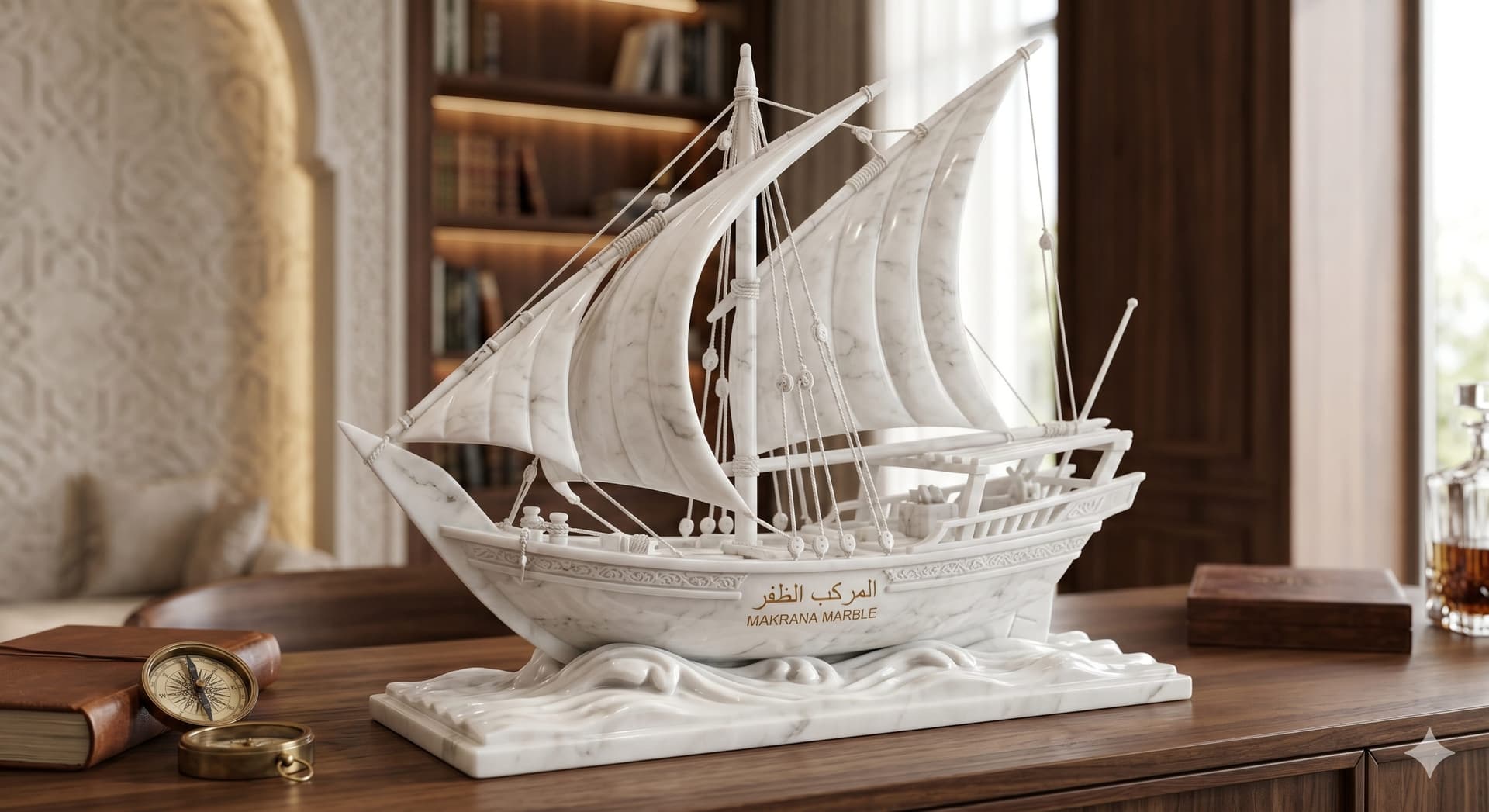
- ◆Sang-e-Taj's dhow collections are carved from certified Makrana marble by fourth and fifth generation craftsmen
Two Thousand Years of the Arabian Sea
The Arabian Sea trade routes predate Islam, predate the great empires of the medieval period, and predate nearly every institution that defines the contemporary Gulf. For at least two millennia, the ports of what are now Oman, the UAE, Qatar, Bahrain, and Kuwait were the hinge points of a maritime commercial network that stretched from the East African coast through the Indian subcontinent to China. Pearls from the Gulf beds. Frankincense and myrrh from the Dhofar coast. Spices from the Malabar Coast. Dates, textiles, and manufactured goods moving in both directions along routes that the dhow navigated by monsoon wind and celestial observation.
The Nakhoda — the dhow captain — was not simply a maritime professional. He was a merchant, a navigator, a diplomat, and the embodiment of a family's commercial ambition across the sea. To captain a dhow was to command considerable social standing, considerable financial exposure, and the navigation knowledge that the routes required: the stars, the monsoon cycles, the harbour approaches of ports from Zanzibar to Calicut. Families whose grandfathers commanded these routes did not inherit a trade — they inherited a way of understanding the world.
The Architecture of the Dhow
The dhow is not a single vessel type but a family of related hull forms, unified by design principles that proved so effective they survived, essentially unchanged, across two thousand years of use. The deep, raked bow. The lateen sail — triangular, pivoting on a long yard, allowing a degree of sailing to windward that square-rigged vessels could not match in the variable winds of the Arabian Sea. The hull planking fastened with hand-twisted coir rather than iron nails — a technique that produced a structure with a degree of flex appropriate to open-sea conditions, without the vulnerability to corrosion that metal fastenings would introduce.
These were not archaic compromises awaiting technological improvement. They were engineering solutions, developed through generations of practical experience, optimised for the specific conditions of the trade routes they served. The persistence of a design for two millennia is an argument about quality that requires no additional commentary.
Why the Dhow Symbol Persists
The dhow appears on the UAE dirham. It features in the iconography of Qatar's National Museum. It anchors the visual language of the Abu Dhabi Corniche development and dozens of institutional identities across the GCC. These are deliberate choices, made by contemporary states whose economies no longer depend on the sea. The choice to centre a heritage symbol rather than a contemporary one is not nostalgic. It is a statement about the source from which the present draws its authority.
Heritage in the Gulf is not sentiment. It is the assertion that what was built before the oil economy — the commercial networks, the navigational knowledge, the diplomatic relationships across the Indian Ocean world — constitutes a foundation that the present inherits and is obligated to honour. The dhow carries this assertion in concentrated form.
What a Dhow Means in a Gulf Interior
The placement of a dhow showpiece in a majlis is not an interior design decision. It is a lineage statement. For families whose genealogy includes merchant captains, for institutions whose identity connects to the maritime foundation of Gulf commerce, for individuals who understand what the sea represented to their grandparents' generation, the dhow in the room is a declaration that requires no explanation to anyone who needs one.
A hand-carved dhow in marble is not a souvenir of heritage. It is a declaration, made in permanent material, about who the family is and where they come from.
Preserving the Form in Stone
Marble is the correct material for an object intended to carry heritage across generations. Permanence in a heritage object is not a bonus — it is the point. A dhow carved in Makrana marble, with its documented 400-year resistance to discolouration, is an object that will be in the room when the commissioner's grandchildren hold their meetings in it.
There is also an unspoken appropriateness in the material choice. Makrana marble moved through the Indian Ocean trade networks — the same networks the dhow commanded — centuries before it became famous as the stone of the Taj Mahal. The marble that arrived in Gulf ports as a traded commodity, the marble that travelled on the same routes that the dhow navigated, is now the material in which the dhow's own form is preserved. The history runs in both directions.
Makrana marble moved through the same Indian Ocean trade routes that the dhow commanded. The history runs in both directions — and the object in the majlis carries both strands of it.
Commissioning a Dhow Showpiece
Sang-e-Taj offers dhow showpieces within the Sang-e-Zafar and Sang-e-Nakhoda collections — fixed forms, defined in scale, carved from certified Makrana marble. For collectors who require a dhow commission tailored to a specific scale, a specific historic vessel type, or personalised with inscription or calligraphy, the bespoke programme allows for a piece designed entirely to order.