Key Facts
- ◆A bespoke commission is a permanent original — no edition, no repeat, no second example
- ◆Standard lead time is 6–8 weeks from brief confirmation; 8–10 weeks for calligraphy or fine inscription work
- ◆Every commission begins with block selection — the artisan inspects the stone before a single tool is applied
- ◆Personalisation options include Arabic calligraphy, institutional crests, family names, and GPS coordinates
- ◆All GCC deliveries are white-glove, crated in custom timber, and include a Certificate of Makrana Origin
- ◆Pricing is determined by complexity, scale, and personalisation — a private consultation precedes every quotation
- ◆Bespoke pieces are signed by the artisan and cannot be reproduced
What 'Bespoke' Means in Stone
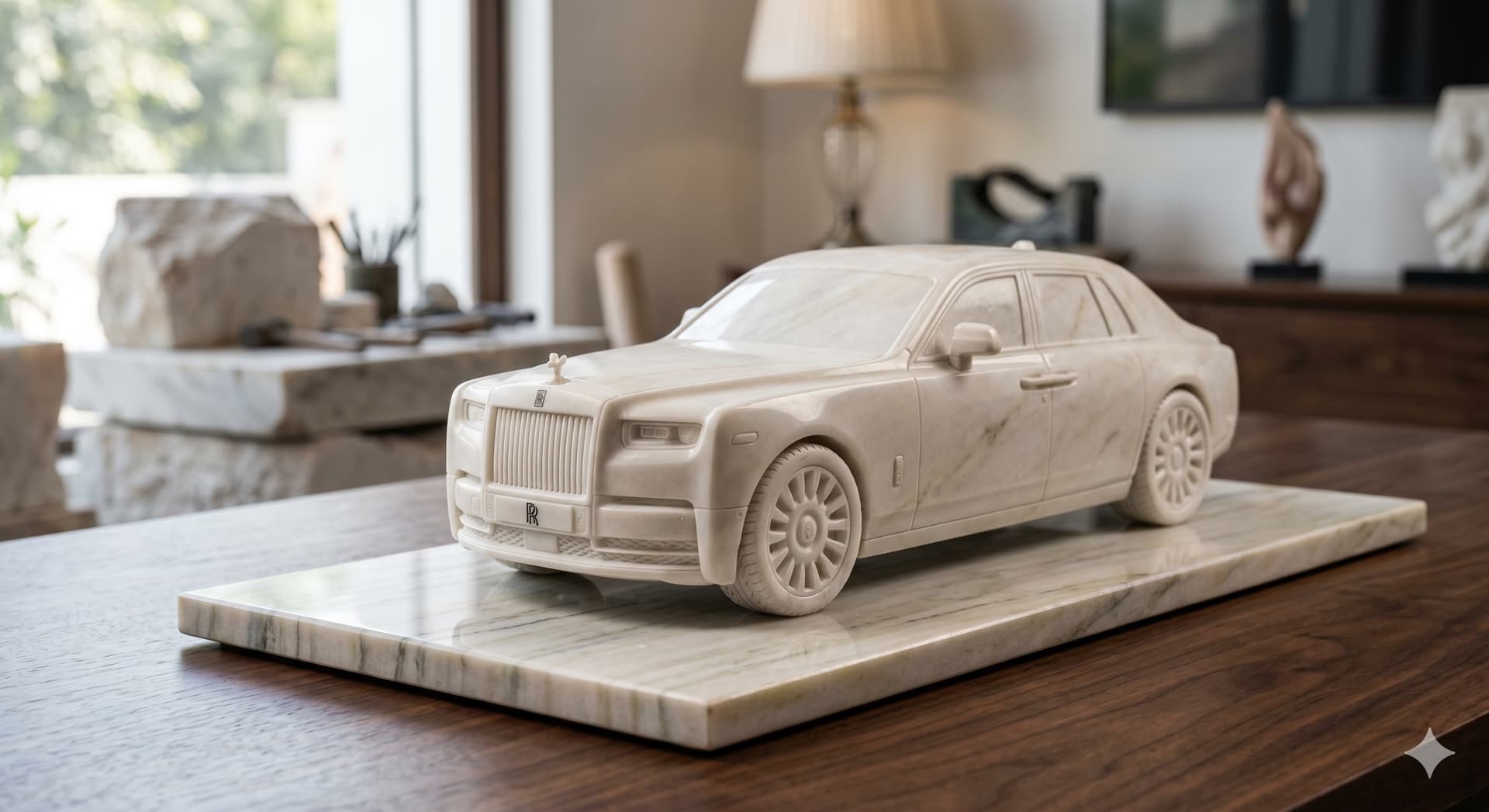
In certain categories of luxury, the word bespoke has been stretched to cover any configuration of a standard product. A bespoke watch is often a standard movement in a personalised case. A bespoke suit may be a house pattern adjusted to measurement. In stone, bespoke means something more absolute. A bespoke marble commission is a piece that has never existed before and will never exist again. It is not an edition of one. It is a singular object, conceived for a specific brief, carved from a specific block, signed by a specific hand. No variation of it will be offered to anyone else.
This distinguishes a bespoke commission from a collection piece, which is a refined, numbered form that exists in a limited series. Collection pieces carry their own integrity — the form is fixed, the craft consistent, the scale defined. A bespoke commission begins without those parameters. The subject, scale, material treatment, surface finish, and any inscription are determined entirely through a dialogue between the commissioner and the atelier. The result is something that could not have been produced for, or by, anyone else.
Choosing the Right Stone
Sang-e-Taj commissions exclusively in Makrana marble, and this is not a constraint — it is a considered position. Makrana is the only white marble on earth with a documented, uncontrolled, four-century track record of zero discolouration. When a commission is intended as a permanent object — something to be placed in a residence or institution and remain there unchanged across generations — the material must be equal to that ambition. Makrana is.
Other white marbles, including Carrara, Statuario, and Thassos, carry distinguished histories and visual merit. They also carry mineral compositions — iron oxide content, dolomitic structures, higher micro-porosity — that produce measurable discolouration over time. For architectural surfaces that are replaced on renovation cycles, this may be acceptable. For a singular object commissioned as a permanent statement, it is not. The choice of Makrana is an act of respect toward the commission itself: the stone will not compromise what the carver creates.
The Brief — What to Decide Before You Enquire
The most productive commission conversations begin with a commissioner who has given thought to four questions before the first contact is made. None require certainty — the atelier's role includes refining and challenging the brief — but clarity on these points shortens the process and improves the outcome.
- ◆Subject: What form does the piece take? A dhow, a falcon, a vehicle, an architectural model, a calligraphic composition, an abstract form? The subject shapes every subsequent decision — the grain of the stone, the direction of the carving, the time required.
- ◆Space: Where will the piece live? A majlis, a boardroom, an entrance hall, a private study? Scale is determined partly by preference and partly by the architecture of the space. A piece proportionally wrong for its setting is a failed commission regardless of quality.
- ◆Scale: Approximate dimensions allow the atelier to propose appropriate sizing. Scale affects lead time, packaging, and price. A clear sense of preference at enquiry stage avoids unnecessary revision.
- ◆Personalisation: Will the piece carry any inscription, name, date, family crest, or other identifying element? Calligraphy and fine inscription add both time and craft complexity. Deciding on personalisation before the brief is finalised prevents late-stage changes that extend lead times.
Lead Times — What to Expect
A standard bespoke commission — a defined subject at medium scale, without calligraphy or complex inscription — carries a lead time of six to eight weeks from the point at which the brief is confirmed and the stone is selected. Commissions that include Arabic calligraphy, fine geometric inlay, or detailed heraldic engraving require eight to ten weeks. Monumental commissions — pieces of exceptional scale or unusual complexity — are quoted individually, with timelines established as part of the initial consultation.
These timelines reflect the work, not a delay in beginning it. Makrana marble is carved entirely by hand. There is no machine stage, no shortcut in the process, and no way to accelerate the craft without compromising it. A commission rushed is a commission diminished. The lead time is part of what is being paid for — the unhurried, disciplined attention of a craftsman who will not move to the finishing stage until the intermediate stage is correct.
The Artisan Process Step by Step
The process begins before the carving does. Block selection — the inspection and approval of the marble from which a commission will be carved — is the first act of craft. An experienced artisan examines multiple blocks, assessing grain direction, crystalline consistency, the absence of internal fissures, and the suitability of the stone's particular character for the subject being carved.
- ◆Block selection: Visual and tactile inspection of candidate blocks; assessment of grain, density, and internal consistency for the specific commission
- ◆Rough form: The primary volume is established using larger tools; excess stone is removed to reveal the approximate mass of the finished piece
- ◆Detail work: The subject emerges through progressively finer tools; this is the longest stage and the one most dependent on artisan judgement
- ◆Surface refinement: Details are sharpened, proportions confirmed, and any inscription or calligraphy executed
- ◆Polishing: The surface is brought to its final state — a process that reveals the full depth of Makrana's crystalline structure
- ◆Signing: The artisan signs the base; the piece is documented and photographed before packaging
Delivery and Presentation
Every commission is crated in custom-built timber before shipping. The crating is designed for the specific dimensions and weight of the individual piece. For Gulf deliveries, Sang-e-Taj uses white-glove handling throughout the logistics chain. Each commission is accompanied by a Certificate of Makrana Origin documenting the quarry source of the stone, the artisan's name and provenance, the date of completion, and the commission brief. It is a permanent record of the piece's identity — material, human, and historical.
How Much Does a Bespoke Marble Showpiece Cost?
Pricing for bespoke commissions is determined by three variables: complexity of subject, scale, and degree of personalisation. A small piece with a defined subject and no inscription represents a different investment from a monumental commission with calligraphy, inlay, and institutional crest work. Sang-e-Taj does not publish a standard price list for bespoke work, because no two commissions share the same parameters.
What can be said is that a bespoke commission represents a meaningful investment in a permanent, singular object. Pricing is discussed privately following an initial consultation, and no commitment is required at enquiry stage.