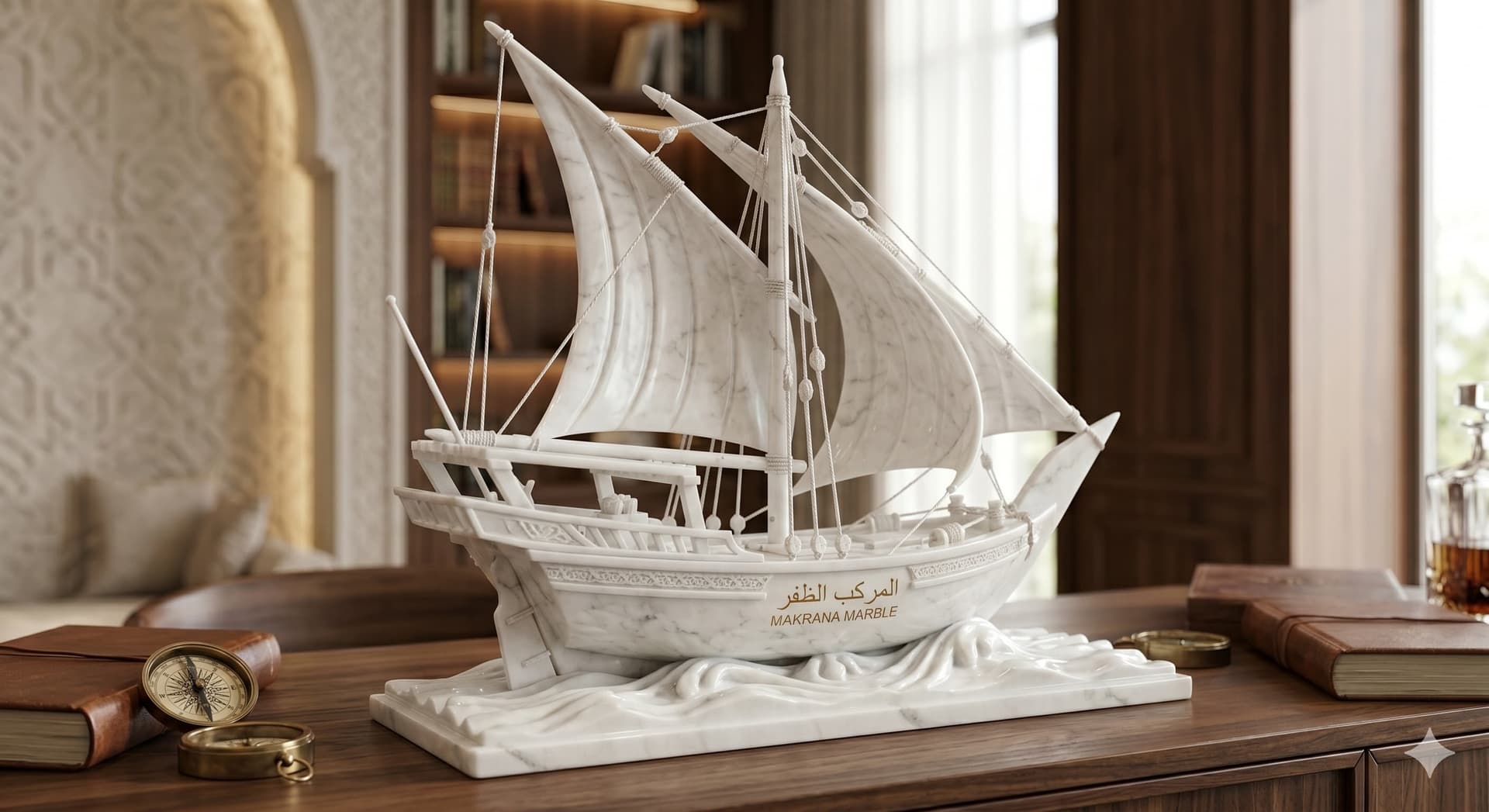
The town of Makrana in Nagaur district, Rajasthan sits above one of the most remarkable geological formations on earth. Beneath its surface runs a seam of calcitic marble so pure and so dense that it was chosen to build the Taj Mahal in the 17th century and continues to be extracted today. The quarries have been continuously active for over 400 years. The stone extracted now is geologically identical to the stone used in 1632.
The Geology of the Seam
The Makrana marble seam lies within the Aravallis, one of the oldest mountain ranges on earth. The marble formed approximately 500 million years ago when limestone deposits were subjected to the intense heat and pressure of tectonic activity, recrystallising into a calcite matrix of unusual purity and density.
The seam runs in bands through the Nagaur district. Different quarry locations within Makrana produce stone of slightly different character — some whiter, some with fine crystal shimmer, some with subtle grain variation. The highest grades — used for monument-quality sculpture and carving — come from the deepest, most consistent sections of the seam.
How the Stone Is Extracted
Makrana marble is quarried in open-cut operations, exposing the seam from above and extracting blocks by cutting along natural grain lines. Traditional extraction used hand tools and controlled splitting — techniques that are still used for fine-grade blocks, because mechanical cutting can introduce micro-fractures that compromise the stone's optical and structural properties.
Large blocks — some weighing several tonnes — are cut from the quarry face and transported to the surface. At this stage, the block is assessed for grade: consistency of colour, absence of inclusions or fractures, crystal quality, and suitability for different applications. Monument-grade stone destined for sculpture is subjected to the most rigorous visual and physical inspection.
Block Selection for Sang-e-Taj Commissions
For Sang-e-Taj sculptures, block selection is carried out by the lead artisan assigned to the commission. The artisan assesses the block in person — examining its colour uniformity in different light conditions, testing its surface for grain direction, checking for internal fractures by listening to the sound the stone makes when lightly struck. A block that does not pass this assessment is not used, regardless of its origin documentation.
The artisan's assessment is not secondary to paperwork. It is the primary quality control. The knowledge of what constitutes suitable stone for carving — versus stone suitable for tiles, slabs, or aggregate — exists in the hands of experienced Makrana craftsmen and cannot be replicated by laboratory testing.
The Quarries Today
The Makrana quarries remain active. The same artisan families that worked them under Mughal patronage in the 17th century continue to work them today, now in their fourth and fifth generations. The stone extracted today is the same geological material as the stone that built the Taj Mahal — same seam, same purity, same crystal structure.
The quarries are finite. The Makrana seam will eventually be exhausted. There is no replacement deposit anywhere on earth. Each block extracted now represents an irreplaceable portion of a geological formation half a billion years in the making. This scarcity is not artificial — it is a physical fact that defines the material value of every Makrana marble object.