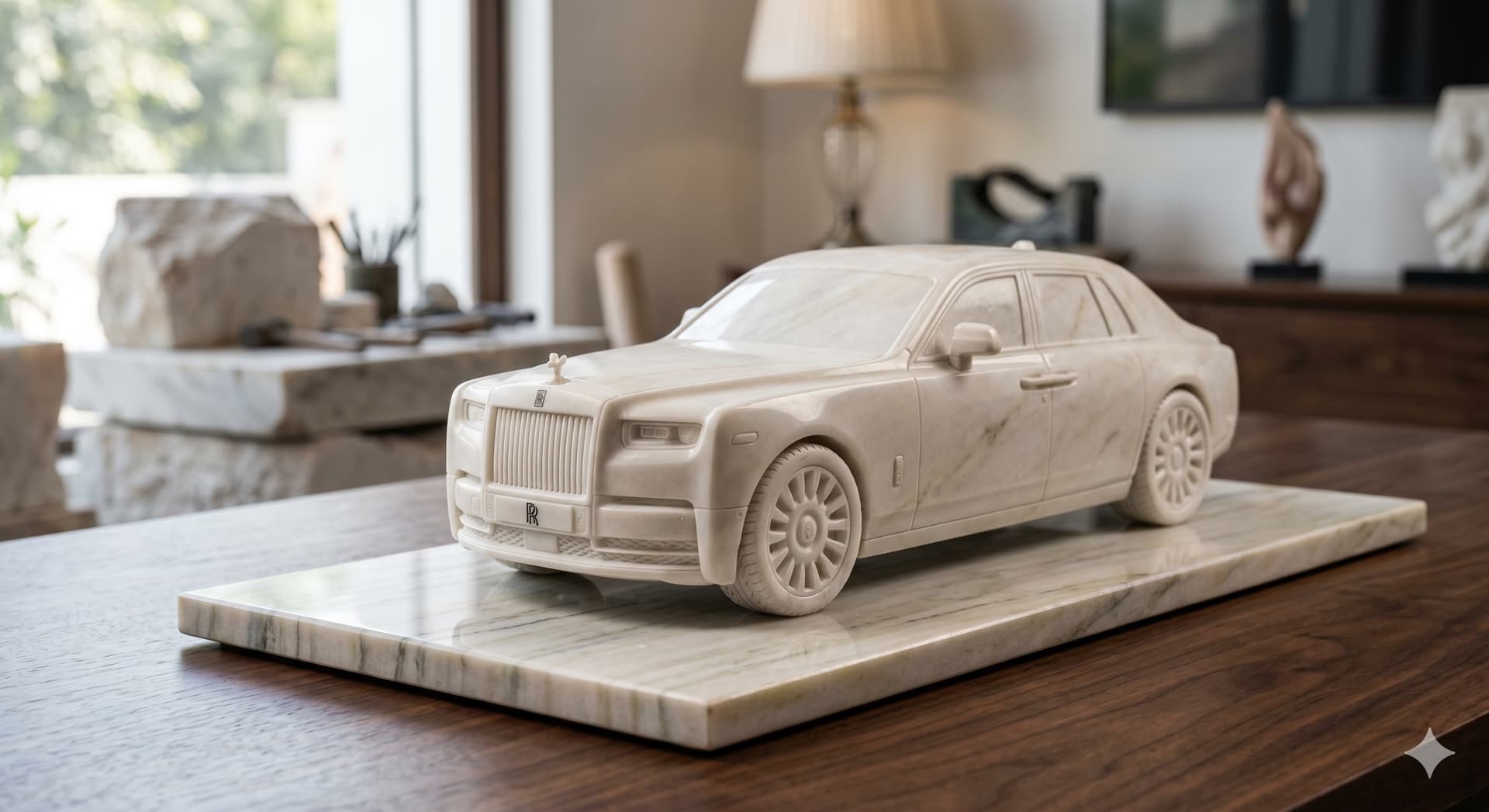
Italian marble — Carrara, Statuario, Calacatta — dominates the luxury interior market. It is the default specification for high-end kitchens, bathrooms, flooring, and wall cladding. It is associated with European luxury, historical architecture, and Renaissance sculpture. It is genuinely beautiful. It is also not the world's best white marble.
That designation belongs to Makrana. The basis for this claim is not aesthetic preference. It is the result of the most rigorous long-term test any building material has ever undergone: four centuries of outdoor exposure on the world's most scrutinised monument.
The Geology — What They Have in Common and What They Don't
Carrara, Statuario, and Calacatta all come from the Apuan Alps in Tuscany, Italy. They are calcitic marbles — the same category as Makrana — formed by the metamorphic recrystallisation of limestone. The geological similarity ends there.
Makrana marble formed over approximately 500 million years in geological conditions that produced an unusually dense, pure calcite crystal matrix. Italian marbles formed more recently and under different conditions, resulting in crystal structures that are less uniform and contain higher concentrations of trace minerals — particularly iron compounds — that oxidise to produce yellowing over time.
The Yellowing Question
This is the central difference. Carrara marble yellows. Not immediately — the process takes years to decades depending on exposure conditions — but it yellows reliably and irreversibly. The grey veining in Carrara, Statuario, and Calacatta is itself evidence of mineral impurities. Those same minerals, under oxidising conditions, produce discolouration over time.
Makrana marble does not yellow. The Taj Mahal has been standing in the open — exposed to monsoon rain, desert dust, thermal cycling, and direct sunlight — since 1653. Its marble is the same white it was on the day of completion. No Italian marble has demonstrated this. None has been tested under equivalent conditions for equivalent duration.
Shah Jahan's architects could have used Italian marble. They chose to transport Makrana 200 kilometres across a desert instead. That decision has been vindicated by four centuries of evidence.
Appearance and Aesthetics
Italian marbles are characterised by their veining — the grey, gold, or dramatic black veining of Calacatta Oro, the subtle cloud-grey of Carrara, the bold white-and-grey drama of Statuario. This veining is visually striking and has become the defining aesthetic of contemporary luxury interiors.
Makrana marble is uniformly white with a faint crystalline sparkle visible in direct light. It does not vein. Its aesthetic quality is depth and luminosity rather than surface drama — the stone appears to glow from within rather than present a pattern on its surface. For sculpture and showpieces, this quality is preferable: the form of the carving is read clearly without competing with mineral patterning.
For Which Applications Is Each Superior?
- ◆Veined feature walls and kitchen surfaces: Italian marbles are the established choice. Their veining creates immediate visual impact. Yellowing over decades is less visible in wall and floor applications than in freestanding sculpture.
- ◆Permanent sculpture and showpieces: Makrana is unambiguously superior. The form of the carving dominates, the pure white provides the ideal ground, and the object will not yellow over the lifetime of its owner or their children.
- ◆Outdoor or long-term installations: Makrana. No Italian marble has demonstrated the permanence required for multi-generational outdoor exposure.
- ◆Heritage restoration where permanence is non-negotiable: Makrana. This is why the Archaeological Survey of India specifies it exclusively for Taj Mahal restoration.
The Conclusion
Italian marble and Makrana marble are not directly competitive for most applications. Italian marbles dominate surface cladding because their veining suits the aesthetic demands of that market. Makrana dominates wherever permanence, purity, and carving fidelity are the primary requirements. For objects intended to exist across generations without degradation — sculptures, showpieces, heritage pieces — there is no credible competitor to Makrana white.