Marble Fountains for Courtyards and Gardens: A Practical Guide
By Aman Khan · October 2026 · 5 min read
A marble fountain brings sound, movement and cool to a courtyard. Here is how to choose the style, size and stone, what the water and pump need, and how to keep it looking clean.
Water has been at the heart of the courtyard for centuries, from the Mughal gardens of India to the riads of Morocco and the houses of the Gulf. A fountain gives a space sound and movement, and the sight of water makes it feel cooler. Carved in marble, it becomes the centre the rest of the garden is arranged around.
Choosing a style
- Tiered fountains stack two or three bowls, with water spilling from one to the next. They suit formal, symmetrical courtyards.
- Basin fountains are a single wide bowl with a jet or a gentle bubble at the centre. They are calm and work well in smaller spaces.
- Wall fountains are fixed to a wall, with water falling from a spout or carved panel into a trough. They save floor space.
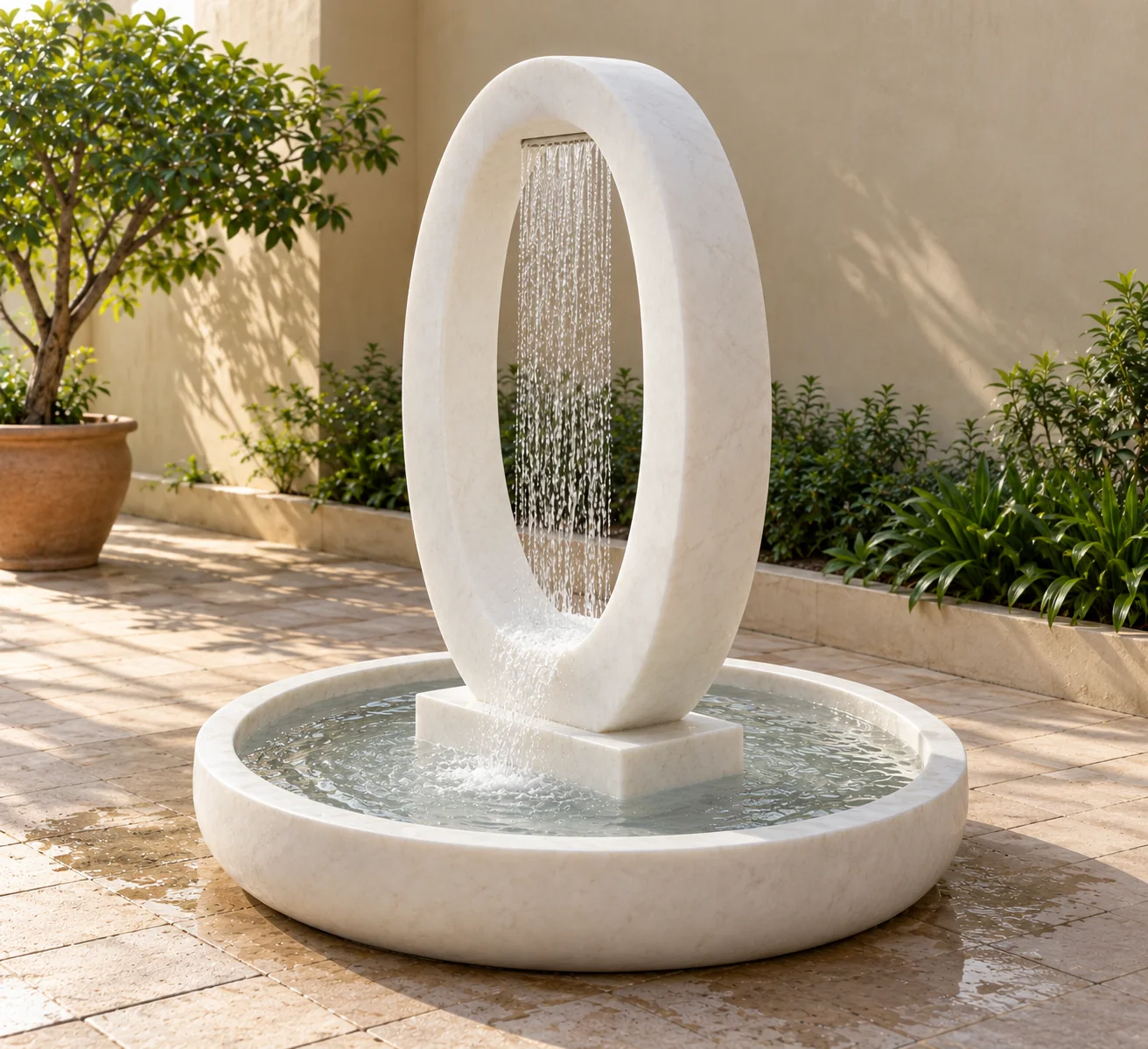
- Contemporary sculptural fountains use a single bold form, such as a tall open oval with water falling through it into a round basin.
Getting the size right
A fountain should be in proportion to the space and to the people in it. In a small courtyard, a fountain that is too large crowds the paths and the seating; in a large one, a small fountain disappears. A good starting point is to mark the footprint on the ground with tape or chalk, then stand back and look at it from the doorway and from where you will sit. Leave room to walk around it and to reach the basin for cleaning.
Think about the sound too. A tall fall of water is lively and can mask street noise, while a low bubble is quieter and better beside a seating area.
The best stones outdoors
Makrana White is dense and holds its colour well, which makes it a natural choice for a white fountain. Travertine Beige gives a warmer, softer look and suits Mediterranean and rustic gardens. Polished finishes can become slippery and show water marks, so most outdoor fountains are given a honed finish. Delicate stones such as onyx are better kept indoors.
If you live somewhere with frost, a marble fountain should be drained and covered in winter. Water that freezes inside the stone or the basin can crack it.
Water, pump and power
Most garden fountains recirculate their water: a small pump hidden in the basin lifts the water to the top, and it falls back to be used again. That means a fountain needs a power point nearby, which is best installed by a qualified electrician, and a way to top up the water as it evaporates. In hot, dry weather a fountain can lose water quickly, so a nearby tap or an automatic top-up is worth planning for.
Keeping it clean
Algae and hard-water marks are the two things that spoil a fountain. Clean the basin regularly, wipe the stone with a soft cloth and mild, pH-neutral soap, and keep the pump filter clear. Avoid acidic descalers, vinegar and bleach, which can etch and dull marble. Running the fountain every day keeps the water moving and slows the growth of algae.
Having one made
Every fountain we make is made to measure for its space. Send us a photo of your courtyard or garden, the rough size of the area, and a picture of a style you like on WhatsApp. We will come back with a design and a written proposal, carve the fountain by hand in Makrana, and ship it crated and insured.
Have a piece in mind? Start a custom order, see how it works or browse the collection.