Key Facts
- ◆Makrana marble comes from a single geographic source: Nagaur district, Rajasthan, India
- ◆Its calcite purity exceeds 98.8% — among the highest of any white marble on earth
- ◆The Taj Mahal has been clad in Makrana marble since 1632 without measurable discolouration
- ◆Active quarrying has continued at the same site for nearly four centuries
- ◆UNESCO inscribed the Taj Mahal as a World Heritage Site in 1983 — its material integrity was a determining factor
- ◆The Archaeological Survey of India uses only Makrana marble for Taj Mahal restoration work
- ◆Sang-e-Taj sources exclusively crystalline-grade Makrana for every commission
Where Makrana Marble Comes From
Makrana marble — also written as Makhrana marble, and both spellings refer to the same stone — originates from a single geographical source: the Makrana tehsil within Nagaur district, in the state of Rajasthan, northwestern India. There is no other place on earth where this stone is found. The quarries that supplied the Taj Mahal in 1632 remain active today, worked by families whose presence at the site stretches back through multiple generations. This geographic exclusivity is not a marketing claim — it is a geological fact that defines the stone's character entirely.
The Aravalli mountain range, one of the oldest geological formations on the subcontinent, provided the conditions under which Makrana marble crystallised approximately 500 million years ago. The combination of extreme pressure, specific mineral composition, and the absence of certain impurities during formation produced a stone with properties that no other deposit, anywhere in the world, has been able to replicate. When craftsmen speak of Makrana, they are speaking of one place, one geological event, and one unbroken tradition.
The Geology — Why It Stays White
The whiteness of Makrana marble is not a surface quality. It is a molecular condition. The stone is composed of crystalline calcite with a purity level exceeding 98.8% — a figure that distinguishes it from virtually every other white marble commercially available. What this means in practice is an absence: an absence of iron oxide, of dolomite, of the mineral impurities that cause other white marbles to yellow, cloud, or patinate over time.
Crystalline calcite, the dominant mineral in Makrana, is naturally resistant to ultraviolet degradation. Where iron oxide impurities in other marbles react with light and atmospheric oxygen to produce discolouration — a process that typically becomes visible within three to five decades — Makrana's near-pure calcite structure remains photochemically stable. This is a geological property, not a treatment that can be applied or that will wear away. The stone arrived from the earth this way, and it will remain this way.
The micro-porosity of Makrana is also significantly lower than comparable white marbles. Denser stone absorbs less moisture, fewer atmospheric pollutants, and resists the kind of surface degradation that afflicts stones of similar appearance but different mineralogy. When you examine Makrana under magnification, you find a uniformly crystalline matrix with a molecular density that explains its resilience better than any laboratory coating could.
Makrana's whiteness is not a surface quality. It is a molecular condition — a geological property that no treatment can replicate and no exposure can diminish.
The Taj Mahal Connection
In 1632, the Mughal Emperor Shah Jahan commissioned what would become the most recognised monument in the world. His architects, working at a moment when Mughal imperial power extended across the subcontinent and his court had access to materials from trade routes spanning Persia, Central Asia, and Europe, made a precise and deliberate choice. They specified Makrana marble — quarried in Rajasthan and transported over 200 kilometres to Agra — for every external and primary interior surface of the Taj Mahal.
The construction employed approximately 20,000 craftsmen over a period of more than two decades. The marble was transported by bullock cart and river barge, a logistical operation of considerable complexity at a time when Carrara and other European stones were known commodities. The selection of Makrana was not a matter of proximity or convenience. It was a material decision made by architects who understood stone, who had access to alternatives, and who chose Makrana because nothing else possessed the same combination of whiteness, workability, and longevity.
In 1983, UNESCO inscribed the Taj Mahal as a World Heritage Site of Outstanding Universal Value. The integrity of its material — the fact that the white marble cladding remains substantially intact and unaltered after nearly four centuries — was central to that designation. When the Archaeological Survey of India conducts restoration work on the monument today, it sources replacement stone exclusively from the same Makrana quarries. No substitute has been found that meets the standard the original material set.
Makrana Marble vs Other White Marbles
The white marble market is not a single category. Several stones present with similar visual qualities at the point of purchase, yet diverge significantly in their long-term behaviour. For anyone considering a permanent interior object intended to outlast its owner, the differences are consequential.
- ◆Carrara (Tuscany, Italy): The most widely known white marble. Contains iron oxide deposits that cause progressive yellowing, typically visible within 30–50 years. The stone of Michelangelo's David and classical Roman sculpture. Workable, historically significant, but not resistant to long-term discolouration under UV exposure.
- ◆Statuario (Tuscany, Italy): A premium variant of Carrara marble, distinguished by dramatic grey veining. Visually striking for bold architectural applications. Carries the same mineral composition and, therefore, the same discolouration susceptibility as standard Carrara over extended periods.
- ◆Thassos (Greece): An island-sourced white marble with a bright, almost luminous surface. Dolomitic rather than calcitic in its primary composition. Lower density than Makrana, more porous, and more susceptible to moisture absorption in humid or coastal environments.
- ◆Makrana (Rajasthan, India): 98.8% crystalline calcite purity. Virtually no iron oxide content. Near-zero micro-porosity relative to comparable whites. The only white marble with a 400-year, in-situ, uncontrolled-condition track record of zero discolouration. The stone of the Taj Mahal.
Makrana Marble Today — The Living Craft
The craft tradition attached to Makrana marble is not a revival. It did not lapse and require reconstruction. It has continued, through political upheaval, industrial change, and the pressures of modernity, in the hands of families who have worked the stone across four and five generations. Techniques developed under Mughal patronage — the management of a chisel across crystalline calcite, the understanding of how the stone responds to different pressures and angles of approach — survive in muscle memory and in the workshops of Makrana and the surrounding region.
What distinguishes this tradition from artisan craft as it is often understood in contemporary markets is its depth of material knowledge. A fourth-generation stone carver does not merely possess technical skill. He possesses an understanding of the stone at a level that accumulates only through sustained, generational contact. He knows which areas of a block will respond to fine detail work and which require adjustment. He understands how Makrana behaves differently from other stones under the same tools. This knowledge cannot be acquired from instruction alone. It is passed by hand, across lifetimes, in the presence of the stone itself.
The craft tradition attached to Makrana marble did not lapse and require reconstruction. It has continued, unbroken, in the hands of families who have worked the stone across four and five generations.
Commissioning a Makrana Marble Showpiece
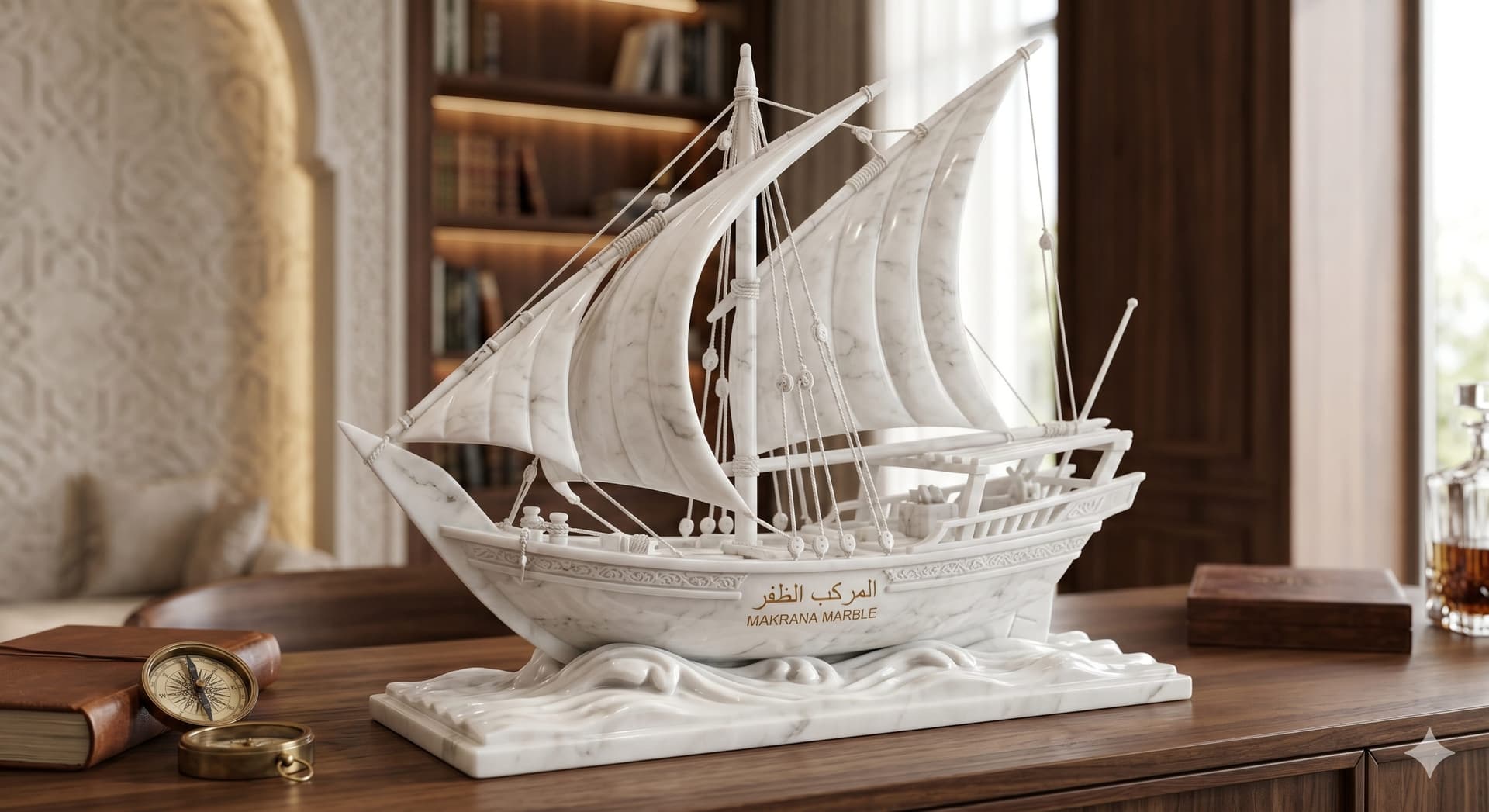
Every piece in the Sang-e-Taj collections is carved from certified Makrana marble by craftsmen working within this tradition. The collection spans forms drawn from Gulf maritime heritage, the aesthetics of luxury transportation, and the geometric vocabulary of Islamic ornament — subjects chosen because they carry cultural weight in the interiors for which they are intended.
For collectors and institutions seeking a commission tailored to a specific brief — a particular subject, scale, inscription, or presentation requirement — the bespoke programme allows for a piece designed from the ground up around the commissioner's needs. Every commission, whether from the collection or created entirely to order, is accompanied by a Certificate of Makrana Origin documenting the provenance of the stone and the artisan responsible for its execution.