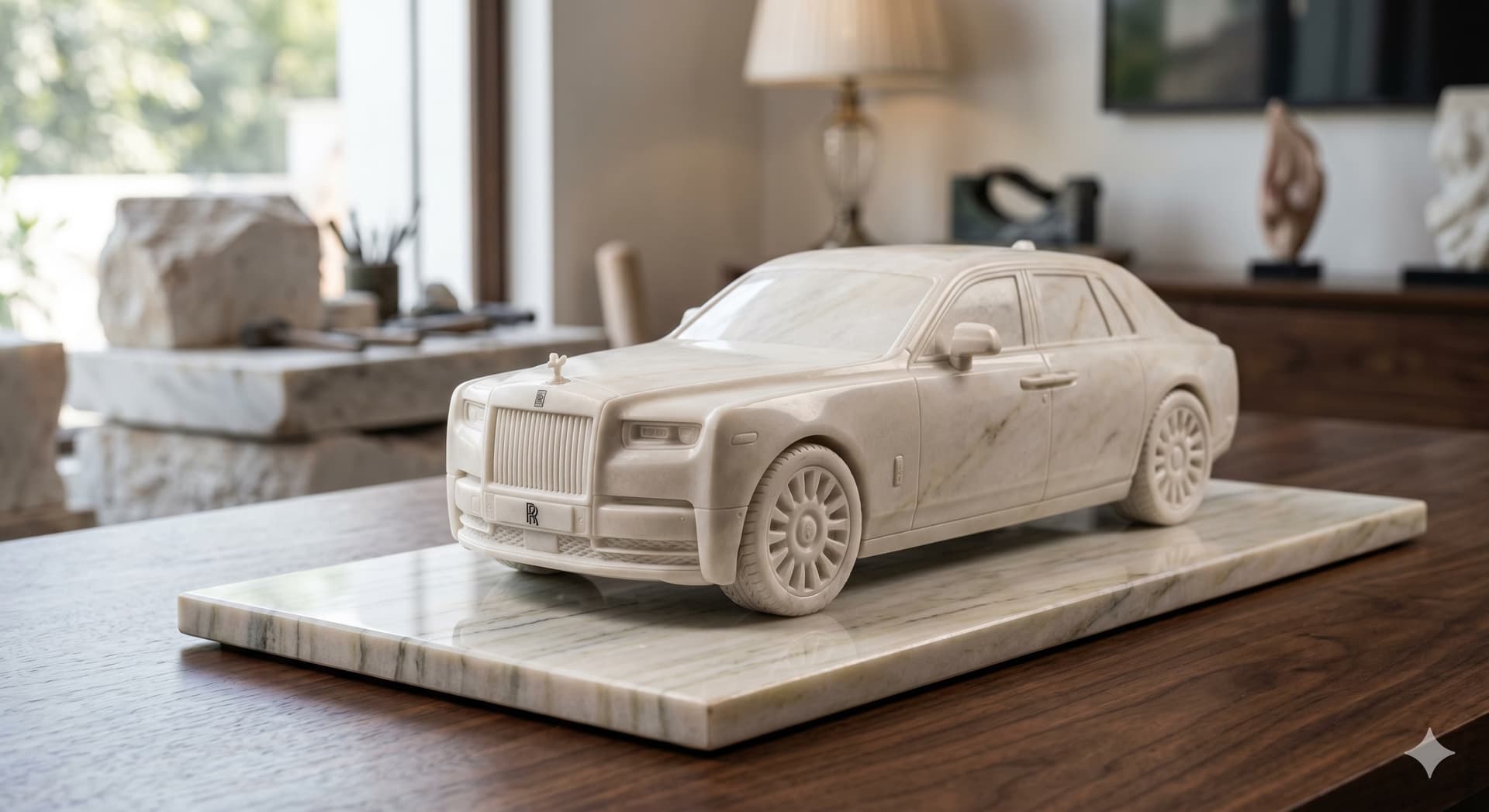
Stand in a marble showroom and ask to see white marble. You will be shown samples from Italy, Greece, Turkey, China, and India. They will all look broadly similar in the brochure. Within twenty years — sometimes within five — all but one of them will have yellowed. The exception is Makrana.
The differences between Makrana marble and every other white stone are not subtle marketing distinctions. They are geological, structural, and historical. This article examines each one.
The Molecular Difference
All marble forms when limestone is subjected to heat and pressure inside the earth, causing the calcium carbonate to recrystallise into calcite crystals. The quality of the resulting marble depends on the purity of the original limestone, the temperature and pressure of the metamorphic process, and — critically — the length of time over which that process occurred.
Makrana marble formed over approximately 500 million years. The result is a calcite crystal matrix of exceptional density and uniformity — crystals so tightly interlocked that the stone behaves differently from other marbles under almost every condition that matters: light, time, heat, and moisture.
Why It Does Not Yellow
The yellowing of white marble is caused by trace mineral impurities — primarily iron compounds — that oxidise when exposed to air and light. This process is chemical and irreversible. Once a marble has begun to yellow, no cleaning or treatment reverses it.
Makrana's quarry seam formed in geological isolation from the iron-rich strata that contaminate most marble deposits. The result is a stone of unusually high calcite purity, low in the minerals that oxidise to produce yellowing. This is not a property that can be achieved by processing or treating a lesser stone. It is baked into the geology of the Makrana seam at a molecular level.
The Taj Mahal has been exposed to monsoon rain, desert wind, and direct sun for nearly 400 years. Its marble is the same white it was in 1653. No laboratory test can replicate that record.
Why It Has Distinctive Luminosity
Dense, pure calcite crystals are partially translucent. Light entering the surface of Makrana marble is scattered and partially transmitted through the crystal matrix before being reflected back — rather than simply being reflected off the surface as it is with opaque stones.
The practical effect is visible: Makrana white appears to have depth. In interior light, particularly the warm diffused light common in Gulf residential and office environments, a polished Makrana marble sculpture does not simply sit in the room. It holds light in a way that other materials — including lesser marbles — do not.
Why It Cannot Be Replicated
Makrana marble exists in one place — the quarries of Makrana, Nagaur district, Rajasthan. The specific geological conditions that produced its crystal structure are not replicated anywhere else on earth. No other Indian quarry produces the same stone. No European, Turkish, or Chinese quarry produces the same stone.
This is documented and legally formalised. Makrana marble holds a Geographical Indication (GI) tag under Indian law — the same protection accorded to Champagne and Darjeeling tea. Only marble from the Makrana region of Rajasthan can legally be sold as Makrana marble.
The Historical Proof
The most convincing evidence for Makrana marble's uniqueness is not a laboratory report. It is the Taj Mahal. Built in 1632 with Makrana white, exposed to extreme outdoor conditions for nearly four centuries, structurally and visually intact. The Archaeological Survey of India specifies Makrana for all restoration work. No substitute stone has been found capable of matching it.
No other white marble in the world has this track record. Not Carrara. Not Statuario. Not Thassos. Not any Chinese or Turkish white. Makrana alone has been tested by time at this scale, under this scrutiny, and passed.